
Atomic Positioning: The complete framework for nailing your positioning
A complete, step-by-step positioning framework for SaaS — not principles, but the actual process. How to pick your ICP, identify your real differentiators, and build positioning that holds up under pressure.
Wanna know what pisses me off? When you follow someone because they promise to teach you something, but they never actually teach you how they do it.
They give you assorted bits of disconnected advice, and expect you to piece them all together. Holding bits back, so you never have all the information.
I don't want to be one of those people, so this article will walk you through my 5-step positioning process.
It looks a bit like this:
Step 1: Discover
Step 2: Research
Step 3: Analyse
Step 4: Big Idea
Step 5: Blueprint
When I first wrote down my process, I was hoping for a really cool acronym that I could pepper all over my website and content.
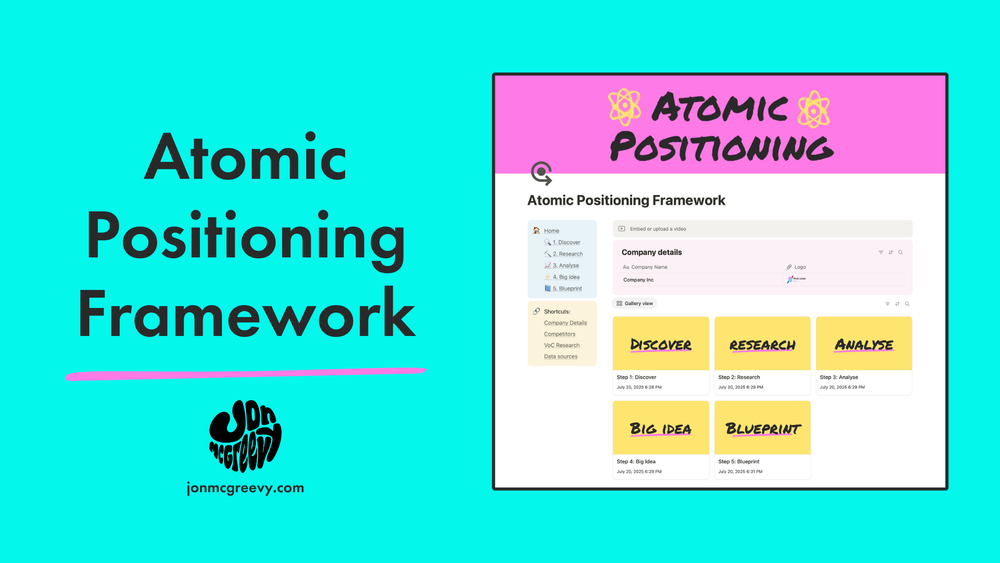
Unfortunately, D.R.A.B.B is an awful acronym, especially for a positioning process. So instead, I'm calling this the 'Atomic Positioning Framework’'.
Note: I'm still not sold on the name, so get in touch if you have any better suggestions
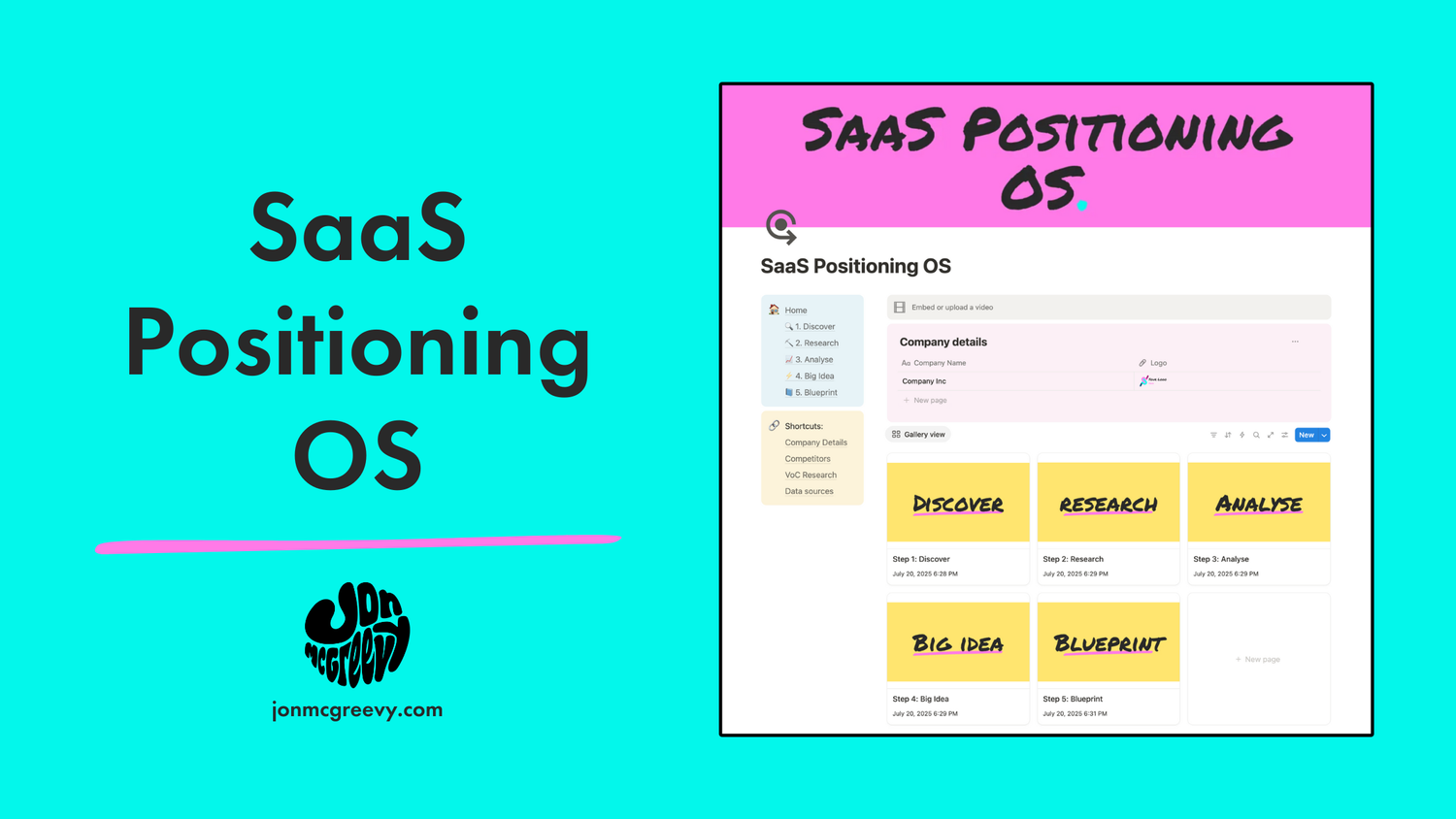
Getting started with the SaaS Positioning OS
To make it even easier to get up and running, I'm sharing my Notion template build specifically for this process.
You can fill this in as you run through this guide. Then by the end, you've got an organised view of your positioning research and outcomes.
Once you've copied the template to your own Notion workspace, enter your company name, upload your logo, then head straight to the first step — Discover.
Step 1: Discover
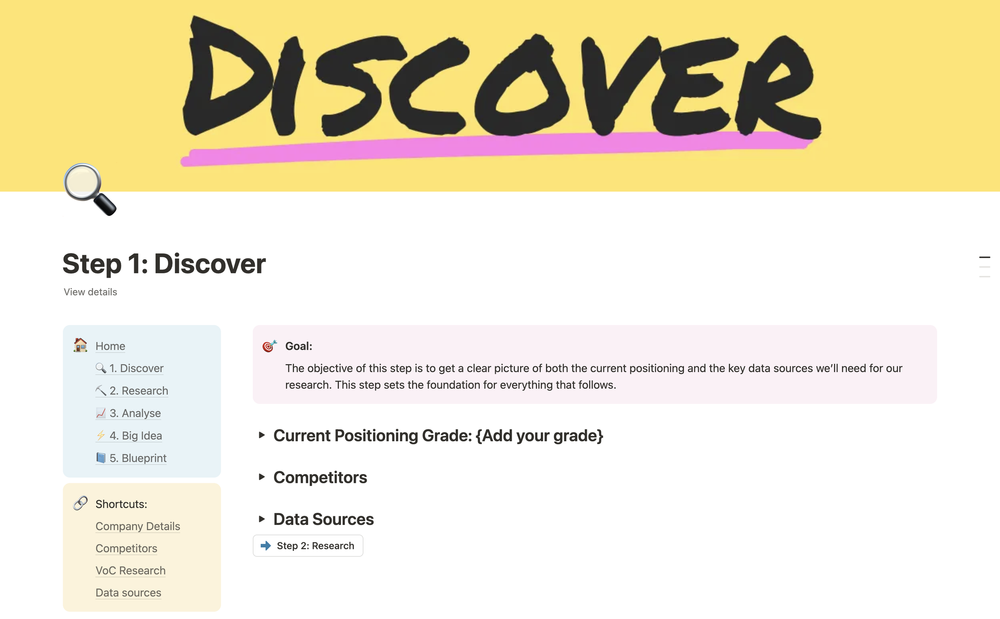
The first step in the process is all about getting the lay of the land. You're taking a look at your current positioning, making a list of your potential competitors, and finding the key data sources you'll need for future steps.
Current positioning grade
The first part of discovery is using the Positioning Scorecard to get a good idea of where you are right now with your positioning.
This is a ten-question spreadsheet that should give you an idea of where you're already strong, and where you need to make improvements.
If you're going through this process, there's a solid chance you've already been through this (or I sent you one as part of a free positioning audit). If not, follow the instructions on the Scorecard blog, then add your scores to the header and company details page.
Competitors
Then we want to make a list of all the key alternatives to using your SaaS to solve their problem.
Don't just focus on other SaaS products here. Also consider non-tech alternatives, or broader tools that can be used to solve the problem.
Here are some examples:
Direct competitors
Spreadsheets
Pen & paper
Hiring someone
Outsourcing
ChatGPT
Doing nothing
For this part, add the competitor name, website (if there is one), and a summary to the Competitors collection. We'll add more to this later on in the next step.
Data sources
We also need to gather all the key data sources we'll need for our research. Not only does this prepare us for the next step, but it also gives us an idea of the job at hand.
You're making a list of all the different data sources available that could help understand the product, customers, market, and the problem being solved.
This will vary based on the maturity of your SaaS, the industry you're in, and a bunch of other factors.
Here are some examples:
Your website
Review sites
Case studies
YouTube videos
Chats with customers
Press coverage
You might not want to research everything in this list for this process, but it's worth noting them down in case you change your mind later on, or need to dig a bit deeper.
Step 2: Research
Right, now it's time to get your hands dirty!
Now, I must warn you, the research stage is the most overwhelming of this process. You'll find yourself under piles of data, unable to make any sense of it.
But keep in mind that the analysis comes later on. Right now, you're just gathering the insights, not trying to understand them or find the gold.
Also, there's no order to this step, especially if you're interviewing people. You shouldn't be holding everything up because your customers aren't available for a few weeks.
VoC (Voice of Customer)
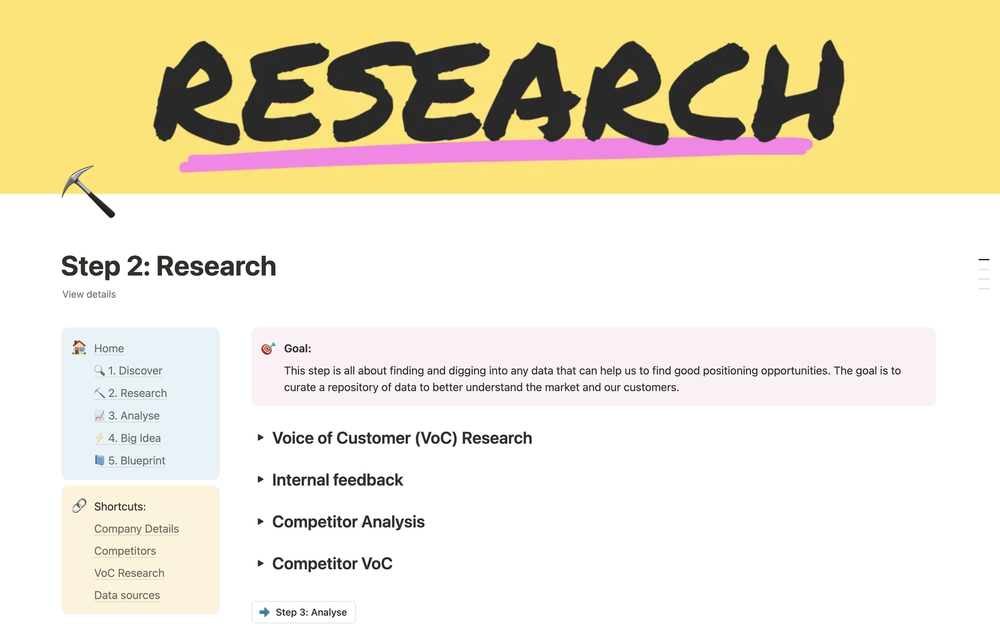
In its simplest terms, VoC research is all about how your customers talk about your SaaS. You want to be finding key quotes that tell you what they like, what they don't like, and why they chose your product.
My favourite way to gather this information is by booking five or so interviews with customers where I can ask them questions, let them tell stories, ask follow-up questions, etc.
But there are a whole bunch of places to find these insights. This is why we gathered those data sources in the last step. Refer to these for a clear idea of the different placed to get more VoC data.
Internal feedback
I need to start this off with a caveat: Your internal team will be very biased and have their own idea of why people use your SaaS.
BUT…that doesn't mean they don't have valuable insights.
Ask around to see what people believe makes your SaaS better than the competition. There might be a clear consensus (that might still be wrong), or they might all say something different, which emphasises the problem you're trying to solve.
If you have a sales team, make sure to get your best salesperson on a call. They will have a good idea of what resonates with customers, and what people couldn't give a toss about.
Competitor positioning
In order to decide the right positioning for your SaaS, you need to understand how your competitors are positioning themselves.
Mostly because you can't stand out if you're saying the same thing. If your closest competitor's differentiator is great service, it probably means you shouldn't go the same way.
Competitor VoC
It's not just your customers voices you care about. You want to know what people are saying about the competition. Review mining is usually the best method of doing this research, but you might find others.
When it comes to the analysis in the next step, you'll probably find some interesting mismatches between how your competitors see themself, and how their customers see them.
Step 3: Analyse
If you're reading this following the research stage…how are you doing? It's a lot of information, and you probably need a few days off.
But if you're ready, let's crack on. The next step is to analyse the research you've just done, to find the diamonds in the rough.
TBH, you've probably already started filling this section in (maybe in your head). As it's impossible to do all that research and not make observations or had ideas. But this is the bit where you officially write these things down.
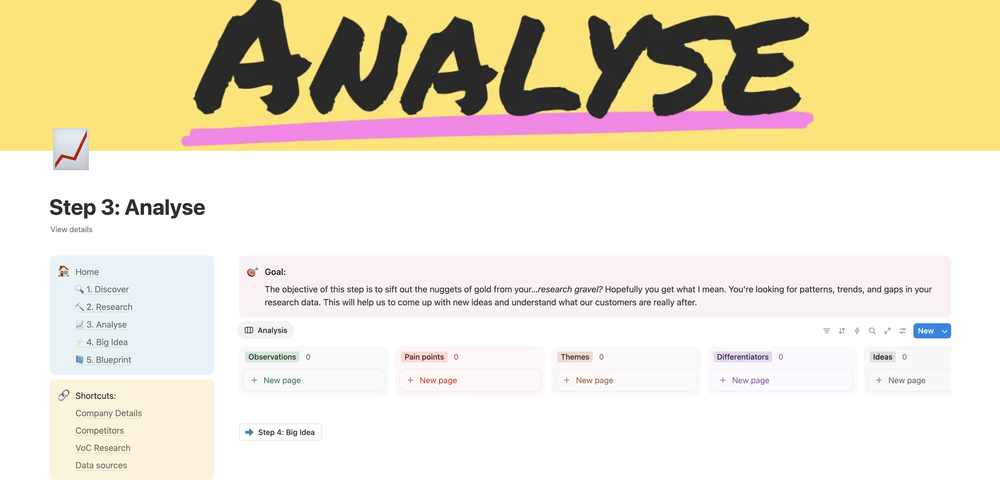
To use this page in the SaaS Positioning OS, you're adding your insights to the corresponding buckets as you go through your research.
Here's a quick recap of each bucket:
Observations: The things that strike you as interesting, even if you're not sure why. Maybe it's a turn-of-phrase in a review, or a particular story from an interview. These are the things that catch your attention, even if you're not quite sure why yet.
Pain points: What are the real day-to-day problems being solved by you or your competitor? What frustrations do you see, and genuine things that make their day worse. We want to find the things that make the biggest impact.
Themes: As you go through your research, you'll notice different themes and recurring topics. Note these down as soon as you notice them, because these themes can be instrumental in finding your new positioning.
Differentiators: What are the unique things you do that the competition doesn't or can't do? In particular, the things your customers are happy about, and their customers aren't. These will be the gaps where you solve a problem no-one else is solving. Or at least not solving well.
Ideas: You never know when inspiration will strike. And it's not wise to wait for the next step to let the creative juices flow. Every time you have an idea or a whiff of inspiration, write it down here. Hopefully this column will be chock-full by the end of your analysis.
Step 4: Big Idea
I'll be honest, this step is a bit…free form.
Sometimes you'll come out of the analysis knowing exactly what the big idea has to be. It'll be an epiphany that just makes sense to you.
But other times you'll have a bunch of ideas, and it'll take many walks, discussions, head-banging, and whatever else you can think of to make it all make sense.
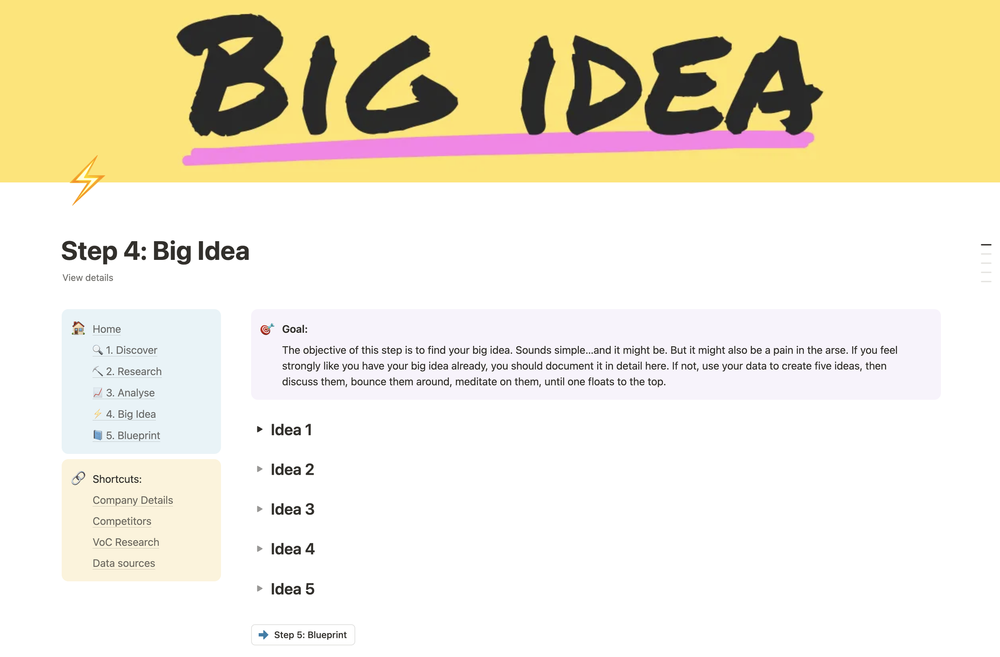
If it's the former, this bit is really easy. You're writing out as much as you can about the big idea you are confident in.
If it's the latter, then you want to identify (at least) five ideas from your research and analysis. Then research them more, ask people, whatever you need to do. Eventually one will emerge as the best option for you.
Step 5: Blueprint
The last step is to create your Positioning Blueprint. This is a short document to be shared internally that summarises your new positioning, and other key positioning and brand details.
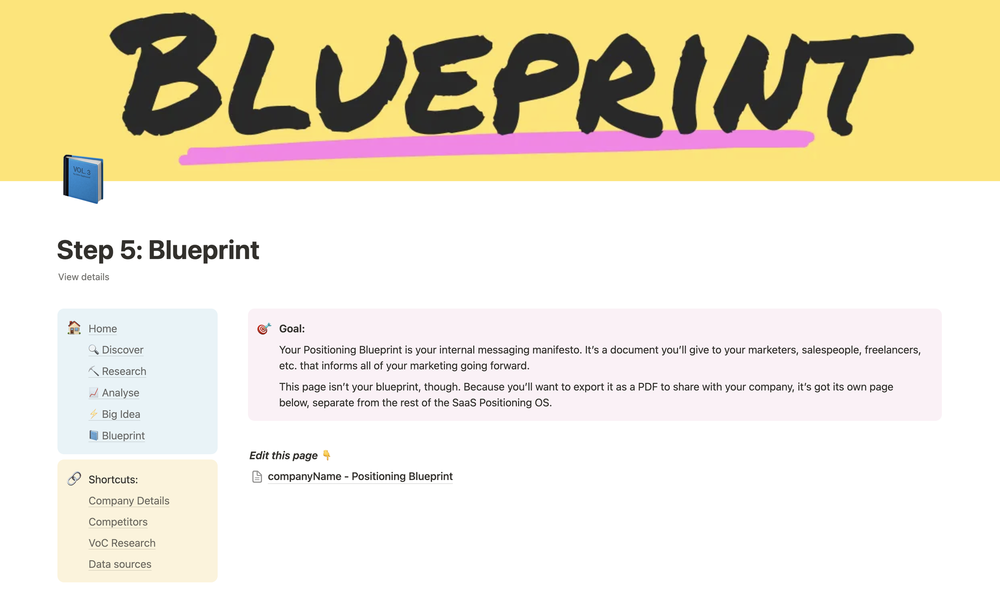
Think of this as your messaging manifesto. When you're inducting new hires, or onboarding a new freelancer, you can give them this document so they understand what you're all about.
This page is separate from the rest of the OS, so you can easily export it as a PDF and share around.
The template is relatively simple, but I'll quickly run through the sections here:
Positioning Summary: This is your two-sentence summary of your new positioning and how you’re better than the competition
Ideal Customer Profile: This is a summary of who you're targeting and the problems you're solving. It's split into two section—demographics and pain points.
Social Proof: This is mostly for the benefit of selling people internally on the new positioning. It's quotes from your research that back up the new direction.
Brand Personality: Split into three sections — core values, tone of voice, and personality traits — this is where you make it clear what you care about, how you talk, and what makes your personality unique. (You went through these in the Discover step).
Messaging Guidelines: This is guidance on what you do and don't want to include in your messaging. For example, you might want lots of social proof, but no mention of the competition.
What to do next
Check out more of my articles on positioning from my blog
For more SaaS marketing and growth insights, check out the SaaSy as Fuck Podcast
Book a chat with me to see how I can help your with your positioning