
How to Audit Your SaaS Positioning: A Scorecard for Growth-Stage Founders
Score your SaaS positioning across five dimensions: ICP clarity, differentiation, value framing, proof, and message consistency. Find out exactly where your positioning is weak and what to fix first.
Most positioning 'experts' are great at waxing lyrical about how important positioning is, but don't actually say anything useful.
GET THE SCORECARD GET THE SCORECARDIt's like a driving instructor saying "try not to crash", then scrolling TikTok for the rest of the lesson.
You don't need to be told how important positioning is, you need ways to actually evaluate and improve your existing positioning. Or if you're just starting that journey, you need to know how to pick the good ideas from the shite.
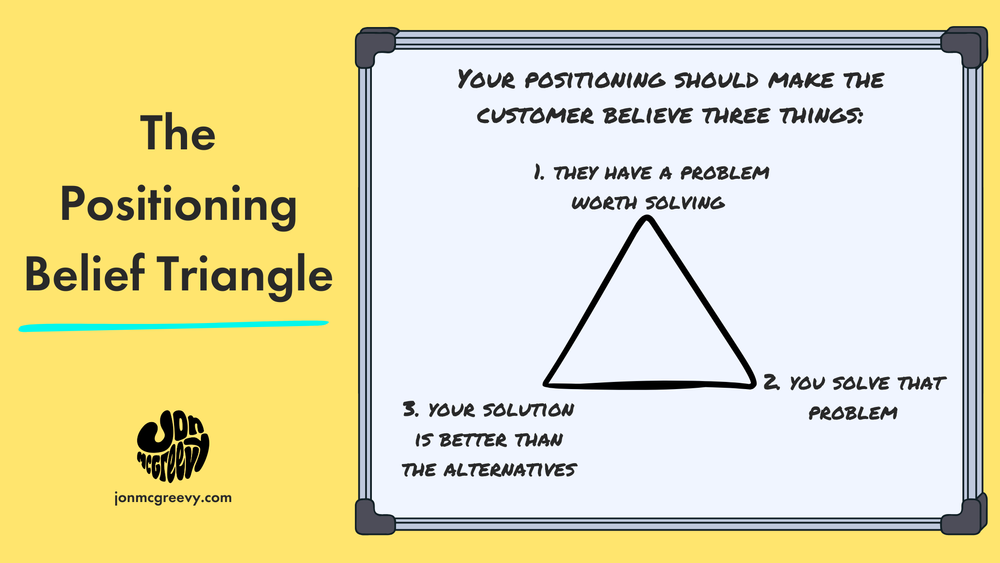
I went into this a bit with my last blog post SaaS Positioning: The Ultimate Guide, talking about the Positioning Belief Triangle.
But this is a very high-level concept, so I wanted to share a more structured and detailed method...
Introducing...the Positioning Scorecard
Since I started offering free positioning audits, I quickly realised I needed a more structured approach. A step-by-step method for analysing a websites positioning.
So I created the Positioning Scorecard — a questionnaire you can fill in which calculates a percentage score for the page. The idea being that as the positioning is iterated and improved, the score will get better and better, until it gets 100%.
The scorecard is focused entirely on your homepage, because that should be the most concentrated example of your positioning.
How to use the positioning scorecard
To get the scorecard you just follow the below instructions:
Click ‘File’ > ‘Make a copy’
Give it a name and save it to your Drive
Add scores next to each question
Badabing-badaboom, you've got your score!
It should look something like this:
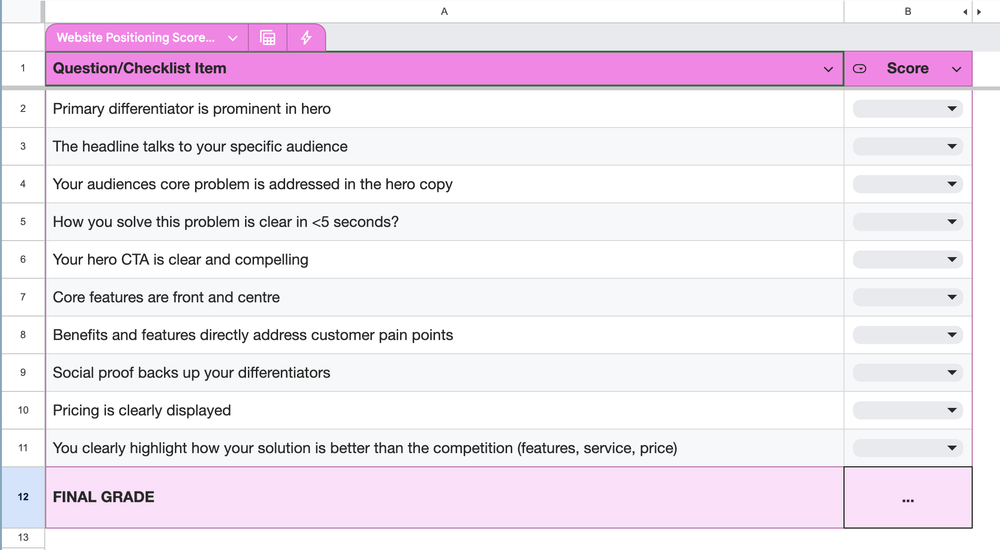
Questions
Let’s quickly run through each question, to give you extra context on what each one means, and how to give it an accurate score.
Primary differentiator is prominent in hero
If you assume people are on your website to compare you to your competitors (and you should), it’s clear why your differentiator needs to be front and centre in your hero.
It doesn’t matter how funny, clever, or cool-sounding your hero copy is. If it doesn’t clearly tell the reader why you’re better than the alternatives, you’re wasting your time.
The headline talks to your specific audience
You need to be hella specific with who you're talking to with your marketing. If you think you're targeting everyone, you're probably targeting no-one.
Then this needs to be reflected immediately in your hero copy. If you target solo accountants, you need them to know this *immediately * from your hero copy.
Your audiences core pain point is mentioned in the hero copy
What is the one key pain point you solve for your target audience? And I mean one — don't reel off every problem you fix in the first sentence.
This one pain point should be front and centre in your hero. Do they not have enough time to market their business? Do they get too many notifications at work? Do they hate reading the word 'holistic' in marketing copy?
Whatever it is, spotlight it here.
(Just make sure it's actually a big pain point for your target audience)
Your solution’s benefit is clear in <5 seconds?
If you've ever looked at landing page analytics, you already know that people do not stick around. They click a link, feel the vibes, then make a split-second decision.
If it takes them 10 seconds to see how your solution benefits them, they'll be gone.
If you save them a bunch of time, make that immediately clear. If you can guarantee they'll be debt free in 30 days, shout it at them.
Don't make them work for it.
Your CTA is clear and compelling
Your hero CTA is the one thing you want the reader to do next. Whether it's start a free trial, book a call, or whatever else.
You've told them your product is for them, you've told them the big problem you solve, and you've highlighted the benefits. Now give them a button to press.
Don't waste this with a pointless 'Read more' button or some other generic bullshit. Tell them what to do, and why they should do it.
Note: You can have other CTA's in your menu, or further down the page. But your hero needs to be building to one big action.
Core features and services are front and centre
Remember, the reader is probably comparing you to a competitor. So you need to put your core offer front and centre. The hero should have hooked their attention — now you need to make it perfectly clear how you solve their problem.
If your key differentiator is a certain feature, or better service, this is where you double down and back up what you said in your hero.
Benefits and features directly address customer pain points
You've hopefully addressed the biggest pain point in the hero, but you also need to address the other pain points you know your ideal customers are facing.
When outlining your products features and service, you should be tying these to benefits that directly correspond to a particular pain point. You want every point to resonate.
Social proof backs up your differentiators
The younger your company, the harder your step is. But you should have social proof all across your website that backs up what you’re claiming. If your testimonials and reviews are generic, they’re not as effective.
For example, if your big differentiator is a certain feature, then your social proof should mention how this feature specifically helped them.
Pricing is clearly displayed
As I’ve said (and will always bang on about), you’re probably being compared to the competition. And you’re mostly being compared on three things:
Features
Service
Price
If you don’t tell them how much your software costs, it makes it impossible for them to easily make these comparisons. If your software is cheaper than the competition, folks will forgive the odd missing features. Or if your price is higher, that can reinforce premium messaging you’ve been giving them.
Note: I know this isn’t always possible, but too often the price is being hidden as some sort of sneaky sales tactic.
Clearly and consistently communicates how your solution is better than the competition
You can’t just mention your differentiator in the hero, and think the job is done. Your website needs to be consistently hammering home your key differentiator.
It should be clear at every step, and in every section why your software is their best option.
Keep in mind the Positioning Belief Triangle (below). It’s not enough for them to believe they have a problem, and that you solve it. They also need to believe your solution is the best one.
What to do next
Get your positioning scorecard, and get started evaluating your positioning.
For more SaaS marketing and growth insights, check out the SaaSy as Fuck Podcast
Book a chat with me to see how I can help your with your positioning